

The global industrial landscape is undergoing a profound transformation driven by the rapid evolution and deployment of robotics. Once confined to heavy automotive assembly lines, robotic systems have matured into highly adaptable, intelligent tools capable of operating across diverse commercial sectors. This shift is not merely an acceleration of traditional automation; it represents a fundamental change in how goods are manufactured, moved, inspected, and delivered.
Several converging factors have accelerated this transformation. Severe structural labor shortages, volatile supply chains, and the rise of high-mix, low-volume production have forced enterprises to rethink their operational frameworks. At the same time, breakthroughs in artificial intelligence, computer vision, and edge computing have given robots unprecedented autonomy and dexterity. As a result, robotics has shifted from a specialized manufacturing asset into a foundational corporate infrastructure.
Automotive Manufacturing and the Electric Vehicle Transition
The automotive industry has historically been the leading adopter of industrial robotics, relying on massive articulated robotic arms for high-speed welding, heavy material handling, and precise chassis painting. However, the global transition toward electric vehicles has completely rewritten the manufacturing rules, requiring a new generation of adaptable robotic infrastructure.
Flexible Battery Assembly Lines
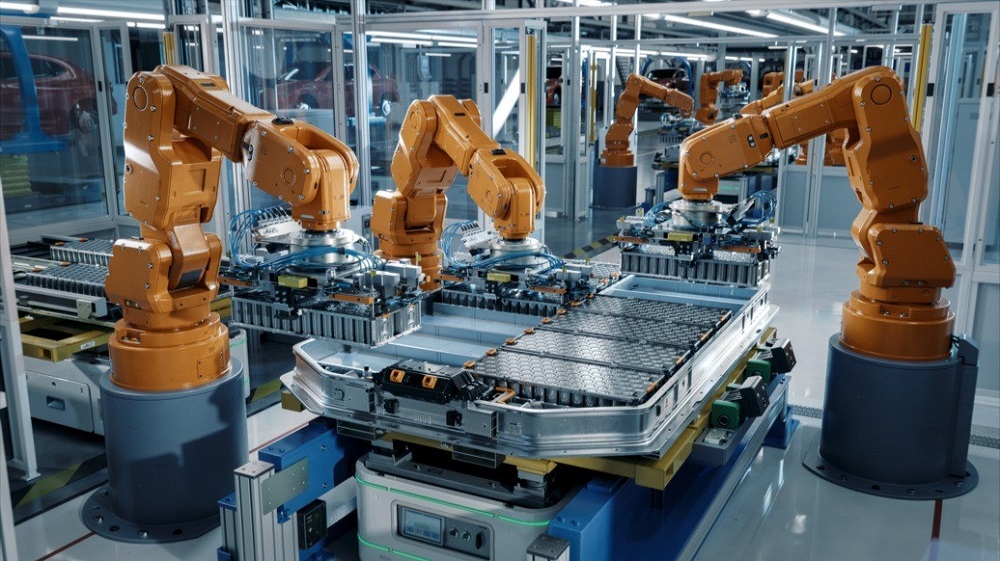
Unlike traditional internal combustion engine vehicles, electric vehicles require the assembly of massive, chemically volatile battery packs composed of thousands of individual cells. This delicate and hazardous process is ideally suited for robotic automation. Advanced articulated arms equipped with thermal imaging sensors and precision gripping tools manage the entire battery lifecycle. These systems lift heavy trays, route complex high-voltage wiring harnesses, and apply precise amounts of thermal adhesive without compromising safety or consistency.
High-Precision Multi-Axis Welding and Joinery
Electric vehicle bodies rely extensively on lightweight materials such as aluminum and composite alloys to offset the weight of heavy battery packs. Traditional spot welding is ineffective for joining these varied materials. Automotive plants now deploy robotic cells equipped with specialized end-effectors for friction-stir welding, mechanical riveting, and structural laser brazing. These robots use real-time force feedback loop systems to ensure that structural seams are perfectly secure, eliminating structural fatigue and reducing material waste.
Logistics, E-Commerce, and Warehouse Mobility
The explosion of global e-commerce has put immense pressure on logistics networks to accelerate order fulfillment times while maintaining absolute inventory accuracy. To cope with this demand, the logistics sector has emerged as one of the fastest-growing markets for service and logistics robotics.
Autonomous Mobile Robots in Intralogistics
Traditional warehouses relied on fixed conveyor systems or manually operated forklifts, both of which require rigid layouts and constant human oversight. Modern fulfillment centers utilize fleets of Autonomous Mobile Robots to execute goods-to-person picking workflows.
These mobile units use light detection and ranging sensors, integrated cameras, and deep learning algorithms to map and navigate dynamic warehouse environments safely. Instead of workers walking miles across warehouse floors to find items, the mobile robots autonomously lift entire product racks and transport them directly to stationary human packing stations, drastically shrinking order fulfillment cycles.
Robotic Sorting and End-of-Line Palletizing
At the final stages of the supply chain, robotics addresses significant bottlenecks in parcel sorting and palletizing. Vision-guided robotic arms fitted with advanced vacuum grippers can pick randomly oriented packages from mixed bins, identify tracking barcodes at high speeds, and sort items onto specific outbound shipping lanes. For heavy end-of-line palletizing, these robots organize crates and heavy boxes onto shipping pallets in optimized geometric patterns, maximizing cargo space and eliminating strenuous manual lifting.
Healthcare, Pharmaceuticals, and Cleanroom Precision
Precision and absolute sterility are the defining parameters of the pharmaceutical and healthcare sectors. Industrial robotics has become indispensable in these fields, performing delicate laboratory analysis, managing chemical compounds, and improving patient outcomes through surgical assistance.
Contamination-Free Cleanroom Automation
Pharmaceutical manufacturing requires strict compliance with good manufacturing practices, where even a single airborne particle or human skin cell can contaminate an entire production batch. Automated robotic arms designed with smooth, non-porous surfaces and fully enclosed joints operate seamlessly within sterile cleanrooms. These machines handle high-throughput compound screening, fill vaccine vials, and package delicate blister packs with zero contamination risk and total compliance tracking.
High-Growth Medical and Laboratory Robotics
Robotics applications have expanded deep into clinical and laboratory settings. Advanced diagnostic robots automate the processing of blood and tissue samples, pipetting micro-volumes of fluid with a level of consistency that eliminates human error. Furthermore, surgical robotic platforms act as highly precise extensions of a surgeon’s hands, utilizing filtered motion control and high-definition visualization to execute minimally invasive procedures, resulting in shorter hospital stays and faster patient recovery times.
Electronics Manufacturing and High-Dextrose Assembly
The electronics sector requires a level of micro-precision and rapid throughput that pushes human physical capabilities to their limits. The continuous miniaturization of semiconductors, smartphones, and wearable consumer tech has made robotic handling mandatory.
Collaborative Robots in High-Mix Assembly
Unlike heavy automotive lines where robots must be enclosed in protective safety cages, electronics factories utilize collaborative robots, or cobots. These light, highly sensitive units are equipped with advanced force-torque sensors that instantly stop motion upon touching a human operator, allowing them to work side-by-side with human workers. Cobots excel at light assembly, applying precise micro-soldering points, inserting delicate ribbon cables, and placing tiny surface-mount components onto printed circuit boards.
Automated Inspection and Vision-Guided Quality Control
Ensuring quality control in dense electronic devices requires advanced automated vision systems. Robotic arms integrated with high-resolution cameras scan assembled components, instantly identifying microscopic soldering flaws, misplaced capacitors, or surface scratches. By executing these visual inspections at line speed, robots prevent defective items from advancing through the supply chain, minimizing product recalls and maximizing material yields.
Agriculture, Soft Robotics, and Food Processing
Agriculture and food processing have historically been resistant to traditional automation due to the fragile, irregular, and highly variable nature of the products involved. The emergence of soft robotics has shattered these limitations, opening up entirely new avenues for industrial automation.
Soft Robotic Grippers for Delicate Food Handling
Traditional rigid metallic grippers would instantly bruise fresh fruit, crush baked pastries, or puncture packaged meats. Soft robotics addresses this by utilizing flexible materials, pneumatic actuation, and bio-inspired designs. These adaptive grippers expand gently around irregular items like tomatoes or eggs, distributing pressure evenly to handle them securely without causing damage. Food processing lines deploy these systems to automate hygienic pick-and-place packaging, dramatically reducing human contact and lowering the risk of foodborne contamination.
Autonomous Field Robotics and Precision Harvesting
Out in the fields, autonomous agricultural robots are addressing acute seasonal labor shortages. Equipped with multi-spectral cameras and machine learning models, these agricultural units navigate row crops autonomously, distinguishing between commercial plants and invasive weeds. They can apply micro-doses of fertilizers directly to specific roots, reduce pesticide reliance, and even identify the exact ripeness of delicate berries or orchard fruits to harvest them mechanically without damaging the surrounding crops.
Frequently Asked Questions
What is the primary operational distinction between traditional industrial robots and collaborative robots?
Traditional industrial robots are heavy, rigid machines designed to execute high-speed, high-force tasks in isolated environments, requiring protective safety fencing to prevent severe human injury. Collaborative robots, or cobots, are lightweight and designed with integrated safety features like force-limiting joints and proximity sensors, allowing them to operate directly alongside human workers without physical barriers.
How does edge computing improve the efficiency of autonomous mobile robot fleets in logistics?
Edge computing allows autonomous mobile robots to process complex navigational data and sensor inputs locally on the device itself, rather than constantly transmitting raw files to a centralized cloud server. This localized processing eliminates data latency, enabling the robots to make real-time decisions regarding obstacle avoidance, dynamic path rerouting, and immediate fleet coordination.
What is meant by the convergence of information technology and operational technology in robotics?
This convergence refers to the seamless linking of a factory’s physical automation hardware, which is operational technology, with the digital enterprise data networks, which is information technology. This connection allows real-time data from robotic sensors to flow directly into enterprise resource planning software, enabling instant inventory updates, automated production scheduling, and predictive maintenance.
How does generative artificial intelligence alter how industrial robots learn new production tasks?
Historically, industrial robots relied on rigid, rule-based programming where every single coordinate and movement had to be manually coded by an engineer. Generative artificial intelligence allows robots to interpret natural language commands and vision-based instructions, translating abstract goals into physical paths by running autonomous simulations to learn new tasks with minimal human intervention.
In what ways does industrial robotics contribute to corporate sustainability and environmental targets?
Industrial robots contribute to sustainability by maximizing material utilization and reducing production errors, which directly minimizes scrap waste. Additionally, advanced automated systems optimize energy usage on production lines by regulating mechanical movements and allowing factories to operate in dark warehouse environments that do not require constant heating, cooling, or lighting infrastructure.
What is agentic artificial intelligence and how does it apply to complex real-world robotics?
Agentic artificial intelligence refers to an advanced hybrid software architecture that combines analytical data processing with adaptive generative capabilities. In a robotics context, this technology allows a machine to independently assess an unpredictable environment, make structured decisions, adapt to unexpected disruptions, and execute complex workflows without relying on a pre-programmed script.